
Where Can I Get Free Music for My Podcast? Safer Sources + What to Check


A track can be free to download and still create problems once it sits in your intro, background bed, or sponsor segment. Platforms and rightsholders care about permission, not the price tag.
Creators get stuck because “free” often describes access, not rights. A download button can exist without a license that covers editing, monetized episodes, and multi-platform distribution. That gap causes claims, removals, and time-consuming re-edits.


Why free podcast music causes problems so often
Creators run into trouble when they confuse availability with permission. A track can sit on a free download page, yet still restrict publishing in intros, background beds, and sponsor segments. The mismatch shows up later, after the show is already live.
Podcast distribution makes that gap more expensive. Episodes get copied, syndicated, clipped, and republished across apps and regions. If a license fails to cover that distribution, a “free” track can turn into replacement work across your back catalog.
The main types of free music podcasters usually look at
Podcasters usually compare a short list of source types. Each type comes with a different proof standard, different license language, and different failure modes. The goal is a clean map of the landscape, so you can choose checks that match the source.
Some sources work well when the terms match your show. Other sources look convenient but collapse under monetization, editing, or platform reposting. Once you know the bucket, you can make faster calls on licenses and proof.
Creative Commons
What is it?
Creative Commons is a set of standard licenses that creators attach to music. Some versions allow reuse with credit, while others limit edits or commercial use. The label “Creative Commons” helps you find options, but the exact license text decides what your podcast can do.
What to verify first?
Confirm the specific license type, then check two workflow points: commercial use and edits. Podcast intros and stingers often require trimming, looping, fades, or ducking under voice. Save the track URL and a dated screenshot of the license page.
Why does it fail?
This fails when creators rely on the label and skip the restrictions. A NonCommercial or NoDerivatives license can break once the show adds sponsors or needs edits. It also fails when attribution gets skipped, or when you cannot prove what license applied on download day.
Public domain
What is it?
Public domain music usually means the underlying composition has no copyright restrictions. That does not automatically cover every recording of that composition. Podcasts use recordings, so you need to confirm the recording is in the public domain or licensed for reuse, not only the song.
What to verify first?
Verify two things separately: the composition status and the recording status. Document where you got the recording and what proof supports it being safe to publish. Save the source URL and a dated screenshot that shows the page and any rights notes clearly.
Why does it fail?
Public domain fails when a creator grabs a “public domain” track that is actually a protected recording. That mistake can surface as a claim, complaint, or forced replacement, especially when you post a video version. Weak sourcing also fails when you cannot show proof later.
Free libraries
What is it?
Free music libraries and stock sites offer tracks at no cost under a house license or terms page. Some cover podcast publishing clearly, while others focus on personal listening or limit distribution. The “free” label is marketing. The license scope is what matters for publishing.
What to verify first?
Check the terms for podcast publishing, editing, and reuse across platforms. Confirm your plan fits Spotify and Apple Podcasts, plus any YouTube version or promo clips. Save the track page, the license page, and any account download record you can access.
Why does it fail?
This fails when the terms exclude commercial use, sponsors, or brand-owned shows, or when they limit use to a narrow channel. It also fails when the library changes its terms later and you saved no proof. Proof packs matter more than memory once a dispute starts.
Commercial music people wrongly assume is fine
What is it?
This is mainstream, commercially released music from popular artists and labels. Creators land here through streaming apps, purchased downloads, reposts on social platforms, or “everyone uses this” tracks. Listening access is common. Publishing permission for a podcast is separate.
What to verify first?
Verify that you have explicit permission to use the recording inside a distributed podcast episode. A streaming subscription or store purchase proves access, not publishing rights. If you cannot point to a license that grants podcast publishing permission, switch sources before you edit episodes around it.
Why does it fail?
This fails because the default rights model for commercial music does not grant broad reuse in podcasts. Problems often show up through complaints, claims, removals, or monetization impact, especially when you post clips to video platforms. The practical fix is replacement, not debate.
What “safe enough” actually means for a podcast workflow
“Safe enough” means the license matches your real use, across the formats you plan to ship. You want permission that covers intros, background beds, stingers, and sponsor segments. You also want clarity on edits, reuse, and the ability to show proof.
Ask workflow questions that map to the license. Can you use the track as a repeating intro across seasons? Can you edit it to fit your timing? Can you place it under voice? These questions surface restrictions fast, before you build muscle memory.
Then check your earning plan and repost plan. Sponsors, ads, subscriptions, and brand-owned shows often count as commercial activity. A YouTube version or promo clip changes risk because detection systems can react differently than podcast apps.
Proof completes the definition. You need a clear source URL, the license text that applied on download day, and a dated screenshot. If someone questions your track later, proof saves time and reduces back-and-forth during review.

Podcast Music Proof Checklist
-
Where did this track come from?(Track page, source URL, license page)
-
How will you use it?(Intro, bed, stinger, trailer, promo, sponsor segment)
-
Will this episode earn money?(Ads, sponsors, subscriptions, client work, branded content)
-
Where will it be published?(Spotify, Apple Podcasts, YouTube, clips, reels, embeds)
-
Can you show what terms applied that day?(Dated screenshot, license text, download record, usage note)
Why Spotify, Apple, and YouTube make this harder
Publishing across platforms raises the stakes because distribution becomes wider and more permanent. Your episode can show up through apps, embeds, RSS players, and search results. If a track sits on unclear rights, the risk shows up after you invest in growth.
Platforms can respond to complaints, policy enforcement, or automated matching. That response can include removal, restrictions, or monetization impact. Your license quality and proof quality often decide how calmly you can handle the moment.
Spotify
Spotify distribution can amplify music issues because a show reaches broader audiences fast. A complaint or enforcement action can remove episodes or create publishing friction. Creators who rely on “free” assumptions often learn the limits once the show gains traction.
Apple Podcasts
Apple Podcasts can still receive complaints even when a creator thought the music use was harmless. Short clips and credited songs can still cause problems if the creator lacks permission. A clear license plus saved proof keeps your response practical and focused.
YouTube podcasts
YouTube raises the risk because audio matching and monetization checks often appear earlier. A podcast posted as a video can trigger claims even when the audio-only release stays quiet. If you plan YouTube distribution, pick sources that hold up there.
| Platform | Typical risk pattern (minimal) | What usually triggers it | What helps most |
|---|---|---|---|
| Spotify | Issue shows up after distribution scales | Complaint about unlicensed music, unclear permission | Clear license text + saved proof pack |
| Apple Podcasts | Rights complaint leads to removal pressure | DMCA-style complaint, disputed ownership | Source link + license screenshot + fast replacement plan |
| YouTube | Automated matching hits first | Content ID match, monetization conflict | Music cleared for video use + proof + fallback track |

Free music options that are often higher risk
Higher-risk options share one trait – the permission story breaks under publishing. They may sound common, convenient, or widely used, but they rely on assumptions. Once a platform, rightsholder, or distributor asks for proof, those assumptions fall apart.
Popular commercial songs sit in the highest-risk bucket unless you have direct permission from rightsholders. Streaming access supports listening, not embedding songs inside your own episodes. A paid subscription does not convert into publishing rights for a podcast intro.
Purchased downloads also create confusion. Buying a track file rarely includes the rights needed for podcast distribution and edits. A store receipt proves payment, not permission. You need license terms that explicitly cover your intended publishing workflow.
Crediting a song does not replace permission. Credit can be part of compliance when a license requires it, yet credit alone does not grant reuse rights. Short clips also carry risk because duration does not automatically change ownership rules.
Fair use also fails as a general fallback for podcast music. Fair use depends on context and becomes a defense after a dispute begins. Platforms and distributors still enforce claims and complaints before any legal debate happens.
A safer workflow before you publish
A safer workflow is simple and operational. You identify the source type, read the license terms, match the terms to your use case, and save proof before publishing. This workflow keeps your process repeatable across episodes and seasons.
Start by classifying the source. Is it Creative Commons, public domain, a free library track, or a commercial song? Classification tells you what to verify. It also prevents you from using the wrong proof method for the wrong type of asset.
Then match the license to your episode workflow. Confirm intro use, editing permission, monetization compatibility, and cross-posting plans. If you plan a YouTube version, confirm your source supports video distribution. Plan for promos, trailers, and shorts.
Save proof before upload day. Store the source URL, license text, and dated screenshots in a folder tied to the track and episode. Add a short note about how you used it. That proof pack saves hours later.
Source
Confirm where the track came from

License
Check the actual terms and scope
Use Case
Define intro, bed, promo, or sponsor use
Platforms
List every place the episode will appear
Proof
Save screenshots, records, and notes
Publish
Release only when the record is complete

FAQs
These are the real questions creators ask when they try to use “free” music in a podcast.
Can I use Creative Commons “NonCommercial” music in my podcast?

CC NC can conflict with real podcast workflows even when you run no ads today. Sponsors, paid subscriptions, brand-owned shows, and YouTube monetization can push episodes into commercial use later. If you want a stable back catalog, pick music whose permission still fits when the show grows.
How do I credit Creative Commons music in a podcast?

Follow the license requirements and keep attribution consistent across episodes. Put the key details in your episode description or show notes, then add the same info to a simple tracking doc for your season. Save a dated screenshot of the license page so your credit matches the terms that applied when you downloaded.
I used “public domain” music and still got a copyright claim. Why?
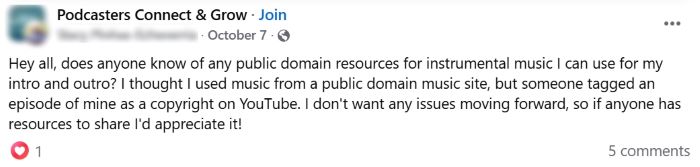
Public domain confusion usually comes from mixing up the song with the recording. A composition can be public domain while a later recording stays protected and claimable. When you use public domain, document both parts: why the song is public domain and where the recording came from.
Is Pixabay safe for free podcast music?
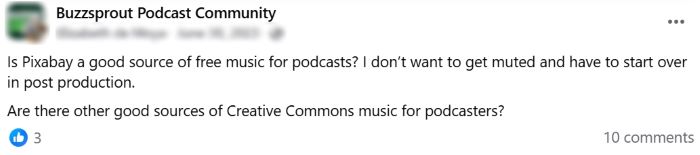
Pixabay can be workable only if the license terms match your podcast workflow and distribution plan. Confirm permission for podcast publishing, edits, and reuse in promos, especially if you also publish on YouTube. Then save the license page and the track page link, so you can prove what you relied on later.
Pick music you can actually defend
You can get free music for your podcast, but the source has to match your publishing reality. Free access does not equal rights. The safer path is choosing sources with clear terms, then confirming those terms cover intros, edits, and distribution.
Save proof before you publish. Keep the source link, the license text, and dated screenshots. When your show grows, that proof turns a stressful claim into a simple response. It also keeps your back catalog stable across platforms.



Audiodrome was created by professionals with deep roots in video marketing, product launches, and music production. After years of dealing with confusing licenses, inconsistent music quality, and copyright issues, we set out to build a platform that creators could actually trust.
Every piece of content we publish is based on real-world experience, industry insights, and a commitment to helping creators make smart, confident decisions about music licensing.


